


Working Principle of a Continuous Fryer
What is a continuous fryer?
A continuous fryer is an automated frying system designed for large-scale food processing. It is primarily used in production environments that require a constant feed of ingredients, continuous frying, and a steady output of finished products. Unlike traditional frying equipment—which relies on manual, batch-based loading—a continuous fryer utilizes a conveyor system to transport food into the frying zone, processing it at a pre-set speed. This makes it well-suited to the requirements of continuous production in food manufacturing facilities.
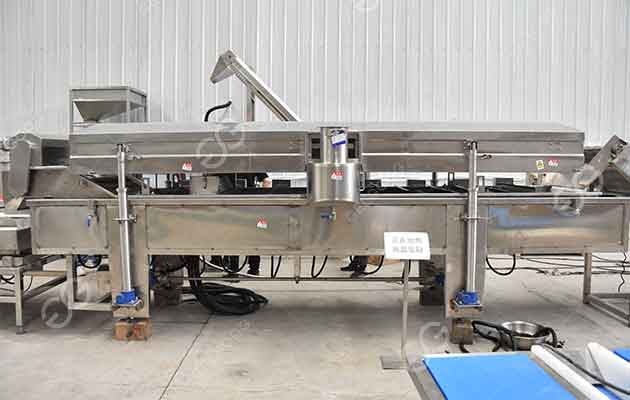
Working Principle of Continuous Fryers
The core operating principle of a continuous fryer involves using a conveyor system to control the movement of food products through high-temperature cooking oil, ensuring that the food is fried under precisely set temperature and time conditions.
1. Continuous Feeding of Raw Materials
Following preliminary processing, raw materials are fed uniformly into the fryer via a feeding mechanism. A conveyor belt or wire mesh belt transports the materials into the frying tank, which helps minimize fluctuations in production rhythm that might otherwise arise from manual feeding.
2. Heating System for Oil Temperature Maintenance
The fryer utilizes methods such as electric or gas heating to supply heat to the cooking oil. A temperature control system monitors the oil temperature against a set value and adjusts the heating process to ensure the temperature within the frying zone remains as stable as possible.
As raw materials enter the oil tank, they absorb a significant amount of heat, which can cause the oil temperature to fluctuate. Consequently, the equipment’s heating capacity, the design of the oil tank, and the responsiveness of the temperature control system all play a critical role in the stability of continuous production.
3. Controlling Frying Time and the Heating Process
Driven by a conveyor system, the raw materials pass through the frying zone at a predetermined speed. Adjusting the conveyor speed allows for control over the duration the food remains in the oil, ensuring it aligns with specific oil temperature settings and processing requirements.
4. Continuous Discharge and Post-Processing
Once frying is complete, the food is carried out of the oil bath by the conveyor belt and moves on to subsequent processing stages. Depending on the type of product, these stages may include oil draining, vibration-based de-oiling, cooling, seasoning, and packaging.
What are the applications of continuous fryers?
Continuous fryers are widely used in the food processing industry, making them particularly well-suited for food manufacturing plants that require high-volume, continuous production.
1. Potato and vegetable chip processing: In the production of potato, sweet potato, or cassava chips, continuous fryers can be integrated with equipment for slicing, rinsing, dewatering, and seasoning. The frying temperature, conveyor speed, and equipment configuration should be tailored to the specific raw material.
2. Nut processing: Nuts such as cashews and peanuts can be processed using continuous frying equipment following preliminary preparation. Key considerations when selecting such equipment include ensuring uniform feeding, stable product transport through the oil bath, and accounting for how different nut varieties and sizes affect the frying process.
3. Other snack food processing: Continuous fryers can also be used for various bean-based products, puffed snacks, and other foods suitable for immersion frying. For raw materials that are irregularly shaped, fragile, or prone to sticking together, it is essential to verify the suitability of the equipment beforehand.
In general, continuous fryers are better suited for food production enterprises that have stable order volumes and aim to increase their level of automation. For operations with lower production volumes or frequent changes in product variety, it is advisable to conduct a comprehensive comparison of the investment and operating costs between continuous and batch-style equipment.
Leave Message For Price

Leave Message